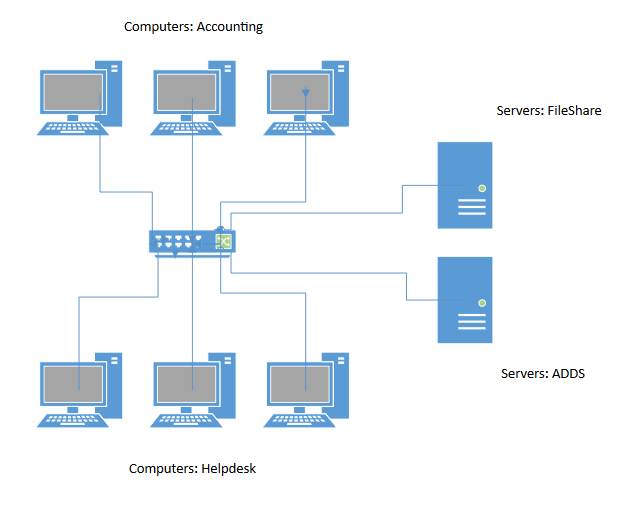

Let’s take a look at an often under-utilized aspect of network topology in the small to medium business realm: that’s right, a networking article. But before you run off, what if I told you you could increase performance and lower your production down time with equipment you (might) already have!?
Topics: Data Protection & Privacy, Incident Response, Monitoring & Detection, Advisory & CAP
During a penetration test, we’ve found that a common (and easy) way to gather credentials and gain an initial foothold on the client’s network is to perform a Man-in-the-Middle poisoning attack abusing LLMNR & NBT-NS. Depending on how active users are on the network, this attack can give an adversary valuable information almost immediately. Fortunately, with a little knowledge, this attack can be easily remediated.
What is LLMNR & NBT-NS?
“What are the top 7 things you can do to protect your business from hackers?” Have you ever read a list like that on the internet? In the cybersecurity realm, they’re everywhere. I’ve even assembled and presented one of those lists to a group of business owners myself. They tend to point out things like user awareness training, patching and passwords. All noble things to get your arms around, of course, but are they useful to a client? Sometimes I feel as though those lists, as true as they are, are about as useful as telling a football team to “score touchdowns”, or “guard the quarterback.” Yeah, I know that scoring touchdowns is good… but how?
Topics: Healthcare, Monitoring & Detection, Advisory & CAP, Compliance & Governance
Everyone has (or should have) an anti-virus solution. It's probably barked at you once or twice for downloading a file from a sketchy website or opening a link from an email you didn't quite recognize. But how does your anti-virus know what programs are bad, and what programs are good?
Topics: Incident Response, Monitoring & Detection, Advisory & CAP
Industry Trends
Cybersecurity in the healthcare field has gone through a lot changes the past few years. In 2016 there was a significant jump in the total number of healthcare specific cybercrimes. According to SecurityIntelligence there was a 71% increase of confirmed data breaches in the healthcare sector from 2015 to 2016. Drilling down on that increase revealed that most of the jump was from external (aka "hacking" or ransomware or malware") followed by internal non-malicious (aka accidents from insiders). Trends are showing that cybercriminals have found more value in healthcare data and the potential for long term use is much higher because it is more difficult to change an individual’s "health data". Another eye-opener is that the type of healthcare entities affected is not limited to hospitals. Business associates, specialized care providers and healthcare plan have all been targets for cyber crime. Oncology, anesthesiology, orthopedic, and radiology are a few of the specific entities that were in the top 10 largest healthcare breaches of 2016. This data tells us that cybercriminals will target or find data outside of the large medical providers and may even be targeting the organizations that have lagged behind in implementing security controls.
Topics: Data Protection & Privacy, Healthcare, Monitoring & Detection