

Five practical steps healthcare organizations can take this quarter, from shadow AI and vendor access to the day an AI tool is wrong and still running.
AI increasingly arrives in hospitals through software they already own. A new feature appears in an electronic health record (EHR), revenue cycle platform, or imaging system as part of a routine update. The vendor is already approved, the contract is signed, and clinicians begin using the capability. No separate procurement process means there may be no separate security review.
That leaves questions many organizations cannot yet answer: Which AI features are enabled? What patient data can they access? Who approved them, and who is responsible when something goes wrong?
For smaller and rural hospitals, the challenge is particularly acute. They often rely on the same AI-enabled vendor systems as larger health networks, with far fewer resources for governance. In a November 2025 Black Book Research survey, small hospitals reported a median 2.3% of IT and quality budgets going to AI governance, compared with 6.8% at large systems.
Here are five moves healthcare organizations can begin making now.
1. See the shadow, and the silent drift
Patient data may be flowing through AI tools that IT and security teams never evaluated.
The shadow consists of tools employees adopt to get their work done: ambient scribes, clinical summary extensions, and diagnostic assistants. In a January 2026 survey of healthcare professionals, 17% acknowledged using unapproved AI at work, often to complete tasks faster.
The silent drift comes from existing vendors enabling AI functionality through software releases. New capabilities appear inside approved systems without necessarily triggering new reviews.
Conventional data loss prevention controls were built to catch files leaving an organization. They may miss language being entered into AI tools or new data flows inside trusted applications.
Consider a privacy incident investigated in Ontario. A physician who had left a hospital remained on a recurring clinical rounds invitation. An AI transcription tool he later installed automatically joined the meeting and captured protected information about seven patients. No attacker was involved. An overlooked calendar invitation allowed an unauthorized AI tool to access clinical information.
Start here: Inventory every AI feature enabled in your environment, including those introduced through vendor updates. Record what data each feature accesses, where its output goes, who approved it, and who oversees it.
2. Inspect the whole supply chain
The scrutiny belongs on the vendor stack, not only on your staff. Every third-party integration that touches patient data holds credentials and permissions that deserve review.
How long do those credentials remain valid? How quickly can you revoke access? Can you obtain an audit log of what a vendor accessed? And who is responsible for responding when that access is compromised?
The 2025 Oracle Health/Cerner breach illustrates the stakes. An attacker used stolen customer credentials to reach legacy Cerner servers that had not yet been migrated to Oracle's cloud, exposing patient information and leaving affected healthcare organizations to make their own breach determinations and notifications.
In June 2026, a federal judge allowed a consolidated class action against Oracle Health and eight health systems to proceed, rejecting an early attempt by the providers to shift responsibility for protecting patient information entirely to the vendor. The ruling allowed litigation to continue; it was not a final determination of liability.
A hospital can outsource the system, but not the duty to protect the patient data inside it.
Start here: Ask your most important AI vendors, in writing, what credentials they hold, how access can be revoked, how quickly revocation takes effect, and whether complete activity logs are available on demand.
3. Govern agents as privileged identities
AI agents that schedule appointments, route prior authorizations, send messages, or update records can act inside connected healthcare systems. When they hold credentials and permissions, they need the same scrutiny as other privileged identities.
The clearest example so far comes from outside healthcare. In August 2025, attackers used stolen OAuth tokens belonging to Drift, Salesloft's AI chat agent, to pull data from customers' Salesforce environments. The tokens were valid, and nothing in Salesforce itself had to be exploited. An authorized AI connection became the route to sensitive data.
Healthcare organizations need to apply established identity controls to AI agents: least-privilege permissions, human approval before patient-impacting changes, execution logs, rate limits, and scheduled credential rotation.
There also needs to be an emergency stop that someone on shift can use at 2 a.m., along with a tested manual fallback for safety-critical workflows. The Health Sector Coordinating Council's Playbook for AI Clinical Resilience offers additional guidance for managing these risks.
Start here: Identify agents that can write to clinical or financial systems. Compare their permissions with the human roles they support, and test how they can be suspended safely.
4. Defend against the zero-cost attacker
The methods attackers use against hospitals are familiar. What AI changes is the cost and scale of using them.
Reconnaissance, impersonation, and personalized follow-up can now be carried out with far less effort. A convincing social engineering attempt that once required substantial preparation can be repeated across many organizations.
In an April 2024 alert, the Department of Health and Human Services described callers posing as revenue cycle employees whose phones were broken. They passed the help desk's identity checks using details gathered from public sources and earlier breaches, enrolled new devices for multifactor authentication, and used the access to redirect payments from payer portals. HHS also warned that AI voice impersonation will make this kind of remote verification harder.
A critical defense is organizational permission: a written rule empowering help desk employees to stop suspicious requests and verify identities through an independent channel, without seeking approval or being penalized for taking extra time.
Start here: Require independent verification for password and MFA resets, banking changes, and urgent requests from executives. Give employees clear authority to pause a request when something does not add up.
5. Bridge clinical governance and cyber
The nurse using an unapproved AI scribe may simply be trying to finish documentation and get home to her kids. Clinicians adopt tools because they solve real workflow problems, and banning them without workable alternatives can drive AI use further out of sight.
Healthcare organizations need approved options that genuinely help clinicians, ways to report problems without punishment, and clinical leadership involved in evaluating AI systems. Chief medical and nursing officers should have a role alongside security, privacy, and compliance teams.
Those groups also need to prepare for a failure mode that traditional downtime planning can miss: the AI is wrong and still running.
An August 2026 research preprint, evaluating 565 notes generated by three commercial ambient scribes, identified failures involving medication information, allergies, and clinical findings. The results are preliminary and sensitive to how errors were assessed, but they illustrate why clinical oversight cannot end when a tool is deployed.
An EHR may remain fully operational while AI-generated information becomes unreliable. Recognizing that problem requires clinicians who understand the output and security teams capable of investigating, containing, and suspending the affected technology.
Start here: Establish a process for clinicians to report inaccurate AI outputs, identify potentially affected records, and pause a tool when necessary. Test that process with clinical and cybersecurity leadership together.
Your first 90 days: Six actions, no new headcount
These five moves can begin with work existing teams are equipped to undertake.
The sequence is straightforward: identify the AI already running, get vendors on the record, test what happens when a tool fails quietly, and give leadership a clear view of progress.
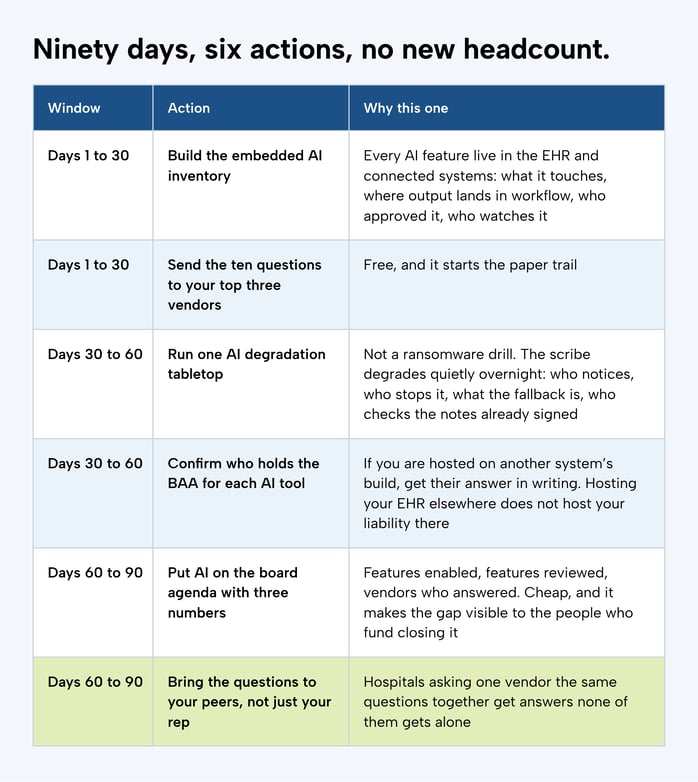
The inventory can also support preparation for proposed changes to the HIPAA Security Rule, which would introduce more explicit technology asset inventory requirements. Those changes are not yet final.
For healthcare organizations beginning this work, the first question is simple: Can you produce a list of every AI feature enabled in your environment today, who turned it on, and who signed off?
If the answer is no, you have your first move.
This article was adapted from "The Next Five Moves: Securing Healthcare in an AI-Driven World," a presentation delivered by ProCircular CEO Aaron R. Warner at HIMSS Iowa on November 5, 2026.